
About
Our History
At First Presbyterian Church, we have been given a living faith handed down from generations of faithful people who have gone before us.
It all began in 1810.
That year, the Rev. William McPheeters was hired to be the pastor of the city. He began holding services in the North Carolina State House until, on January 21, 1816, First Presbyterian Church was officially organized there in the State House, with the Rev. McPheeters presiding.
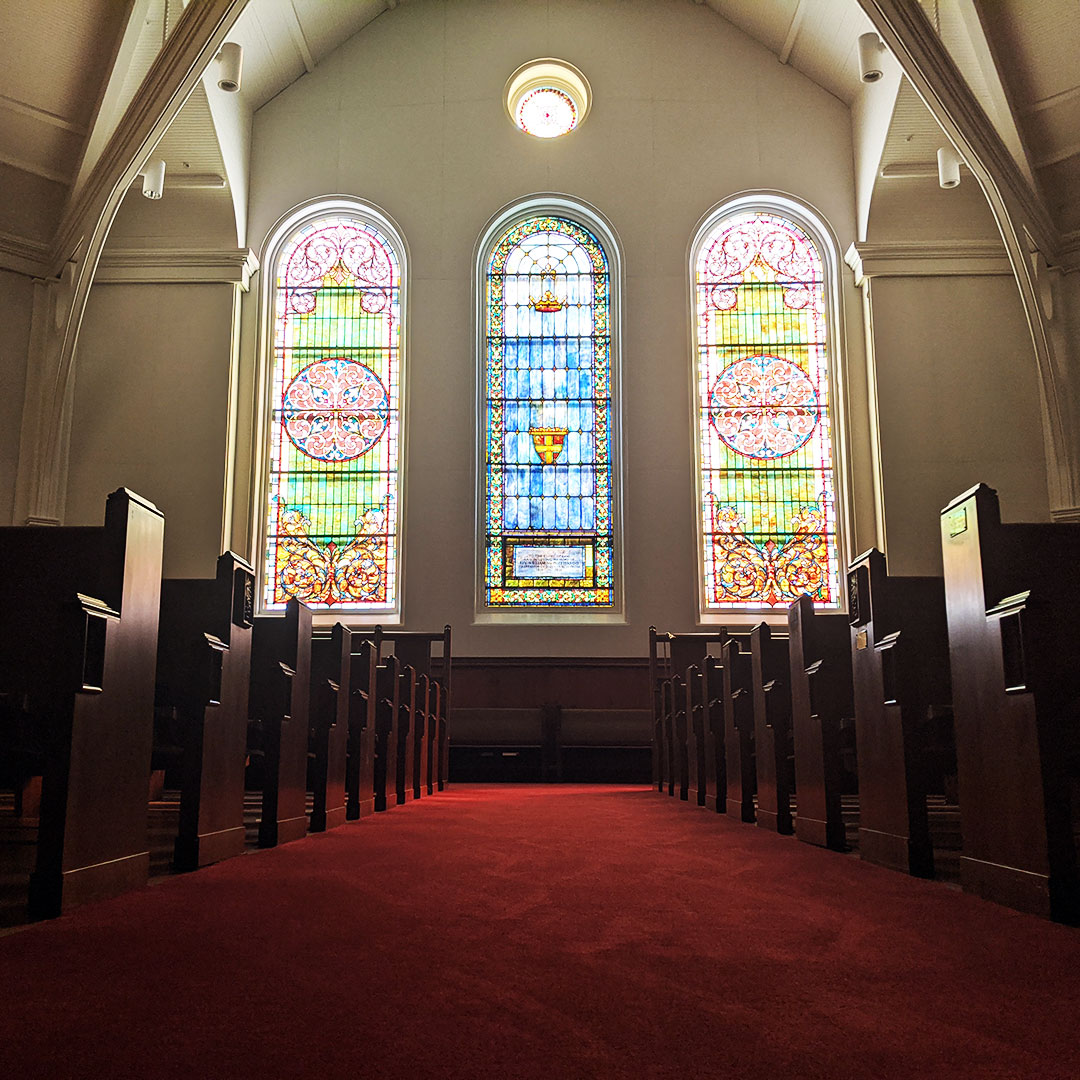
Construction on the first brick church in Raleigh began in February 1816, and was completed on July 4, 1818. There we still stand today, at the corners of Salisbury and Morgan Streets, across from the historic North Carolina Capitol. The current sanctuary dates from 1900.
During the antebellum period, almost all public, governmental, or political meetings that required a large assembly were held at First Presbyterian, and the bell in the church’s tower was used as a fire alarm to call volunteers to fight fires, a frequent occurrence in 19th century Raleigh.

Membership at FPC increased greatly in the mid-to-late 19th century. At that time, FPC also planted or formed many churches in the greater Raleigh area. Churches seeded by this congregation include Milner Memorial, St. Barnabas, Westminster, West Raleigh, Ernest Myatt Presbyterian, and White Memorial. In addition, churches in Fuquay-Varina, Willow Springs, and Mount Pleasant were formed.
In 1857, William Peace, a founding trustee of FPC, gave eight acres and $10,000 to establish a college for women. This legacy still stands today as William Peace University, and our church’s long association and support of the college remain.
Twentieth Century and Beyond
Our church has continued to flourish into the twentieth and twenty-first centuries. In addition to Rev. McPheeters, our ministers have included Dr. Drury Lacy (1837-1854), Dr. William McClanahan White (1908-1934), Dr. James Sprunt (1951-1957), Dr. Albert G. Edwards (1958-1986), Dr. Edwin W. Stock (1988-2002), and Dr. Edward A. McLeod (2004-2023). Our current minister, Dr. Tara W. Bulger, is our first female Senior Pastor and Head of Staff.
It is this long tradition of faithfulness and service that is at the heart of who we are as a church. Our tradition is not something that binds us, but rather is the foundation for all that we will do going forward in mission and ministry.